
Impact of Global Interest Rates on Indian Equity Returns (2026)
Posted On : Thu Jan 01 2026
Introduction
Global interest rates have quietly become one of the most important drivers of equity markets worldwide. When central banks — especially the US Federal Reserve — raise or cut rates, the ripple effects are felt across currencies, capital flows, valuations, corporate borrowing costs, and ultimately, investor returns.
As we look ahead to 2026, the big question for Indian investors is:
How will the next phase of the global interest rate cycle influence Indian equity performance?
At Waya, as a SEBI-registered Research Analyst (RA) and Portfolio Management Services (PMS) provider, our focus is not on guessing central bank decisions — but on understanding risk, liquidity and valuation trends — so portfolios are positioned intelligently.
Let’s break it down.
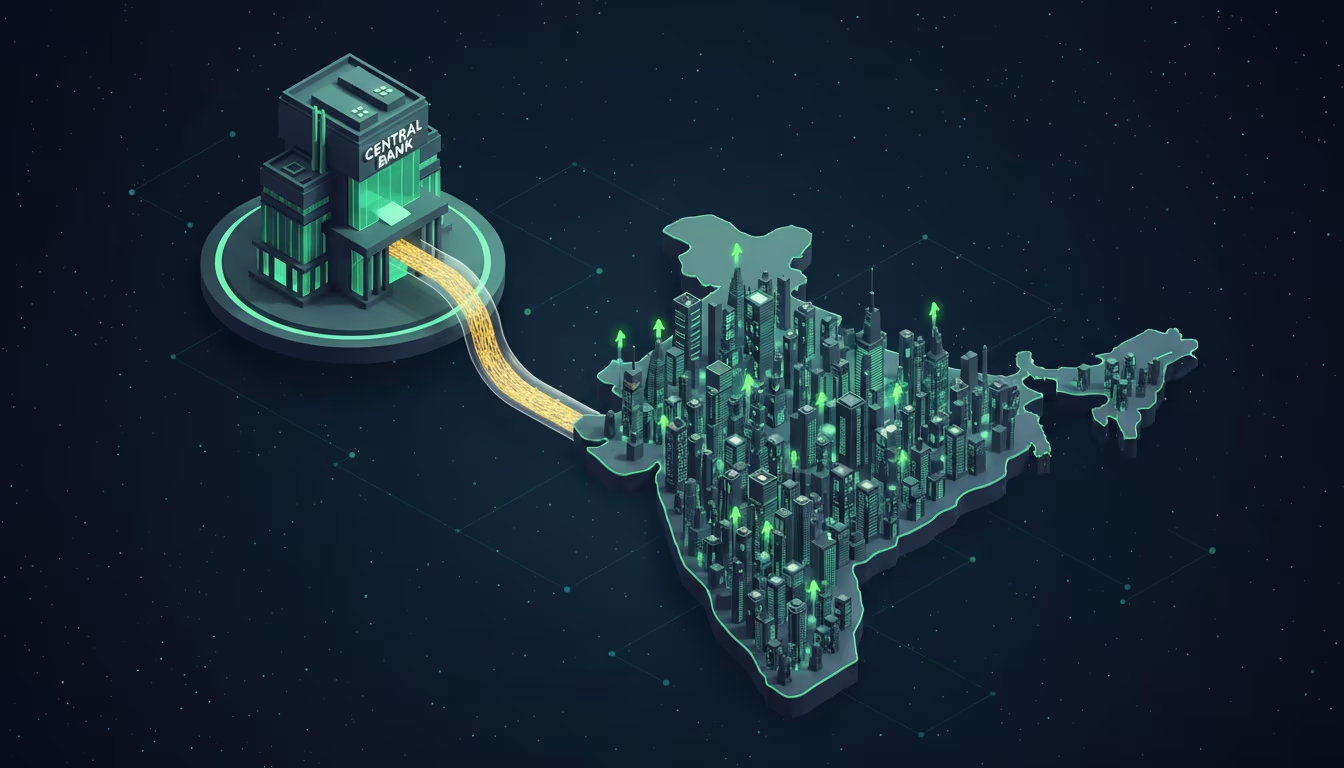
Why Global Interest Rates Matter to Indian Markets
1️⃣ Capital Flows Follow Yield & Risk
When global interest rates are high:
- Bonds become attractive to global investors
- Risk appetite reduces
- Emerging market equities may see selective outflows
When rates soften:
- Liquidity increases
- Risk appetite improves
- Equity allocations rise
India — as one of the world’s fastest-growing major economies — often benefits strongly during easing cycles.
2️⃣ Cost of Capital Shapes Valuation
Lower global rates generally:
- Reduce borrowing costs
- Support business expansion
- Sustain premium valuations for quality companies
Higher rates do the opposite.
This directly affects corporate earnings, discount rates used in valuation models, and the risk premium demanded by investors.
3️⃣ Currency & Rupee Stability
Global rate trends influence the Indian Rupee (INR) through dollar strength or weakness, trade balances, and investor risk appetite.
A stable currency supports foreign investment flows — critical for equity stability.
Where Are We in the Global Interest Rate Cycle Now?
Global central banks are transitioning from an extended rate-tightening phase toward a more neutral–to-moderate easing environment, driven by cooling inflation, slowing global growth, and the need to support demand.
This means liquidity conditions are likely to gradually improve rather than tighten further — with meaningful implications for Indian equities heading into 2026.
What This Means for Indian Equity Returns in 2026
✅ Scenario 1 — Gradual Rate Easing (Base Case)
Most probable environment: inflation under control, gradual global moderation, and measured rate cuts.
- Steady foreign inflows
- Valuation support for quality companies
- Continued earnings-led returns
This favors large-caps, quality mid-caps, and strong balance-sheet companies.
⚠ Scenario 2 — Rates Stay Higher for Longer
If inflation remains sticky and borrowing costs stay elevated, risk appetite may soften.
- Selective equity performance
- Rotation into quality & defensives
- Lower valuation multiples for speculative areas
Risk management becomes critical.
🚀 Scenario 3 — Aggressive Rate Cuts
If global growth weakens meaningfully, central banks may respond aggressively.
- Short-term market enthusiasm
- Higher volatility
- Earnings resilience becomes the differentiator

Why India Remains Structurally Attractive
- Strong domestic demand
- Corporate earnings growth
- Capex revival
- Financialisation of savings
- Rising household equity participation
Domestic flows have increasingly reduced dependence on global capital swings, helping market stability.
How Smart Investors Should Think About 2026
- Staying allocated to core equities
- Using diversification thoughtfully
- Respecting risk & valuation
- Seeking professional advisory
The Role of PMS & Regulated Advisory in This Environment
- Research depth
- Structured asset allocation
- Risk frameworks
- Review discipline
- Transparency
The Waya Approach
Waya delivers regulated services through Equity Advisory, FnO Advisory, Commodity Advisory, and Portfolio Management Services (PMS).
Protect. Participate. Compound.
Global interest rate cycles will continue to influence liquidity, valuations, and investor behaviour in 2026 — but India’s structural growth story remains intact.
Wealth creation is built over cycles — not in reaction to them.
Invest with clarity. Grow with discipline.
Regards
Amit Vora, CEO