
The Venezuela Pivot: Impact on Global Crude Oil and Capital Markets in 2026
Posted On : Mon Jan 05 2026
In early January 2026, the global geopolitical landscape was jolted by a historic shift: the U.S.-led military operation (Operation Absolute Resolve) that resulted in the capture and removal of Venezuelan President Nicolás Maduro.
For investors and market participants, this is not just a political headline—it is a seismic event for energy markets and emerging market (EM) debt. At Waya Financial Technologies, we believe in decoding global complexities into actionable insights. Here is our analysis of the Venezuela crisis and its ripple effects on crude oil and capital markets.
Venezuela holds the world’s largest proven oil reserves (over 300 billion barrels), yet its production has been in a decade-long death spiral. Under the Maduro regime, mismanagement and sanctions saw output plummet from 3.2 million barrels per day (bpd) in the 1990s to roughly 800,000–1 million bpd in 2025.
The removal of Maduro on January 3, 2026, has created a "geopolitical vacuum." While the U.S. has signaled a desire to "run" the transition and revitalize the oil sector, the immediate reality is a total export blockade and PDVSA (the state oil firm) shutting down wells due to lack of storage.
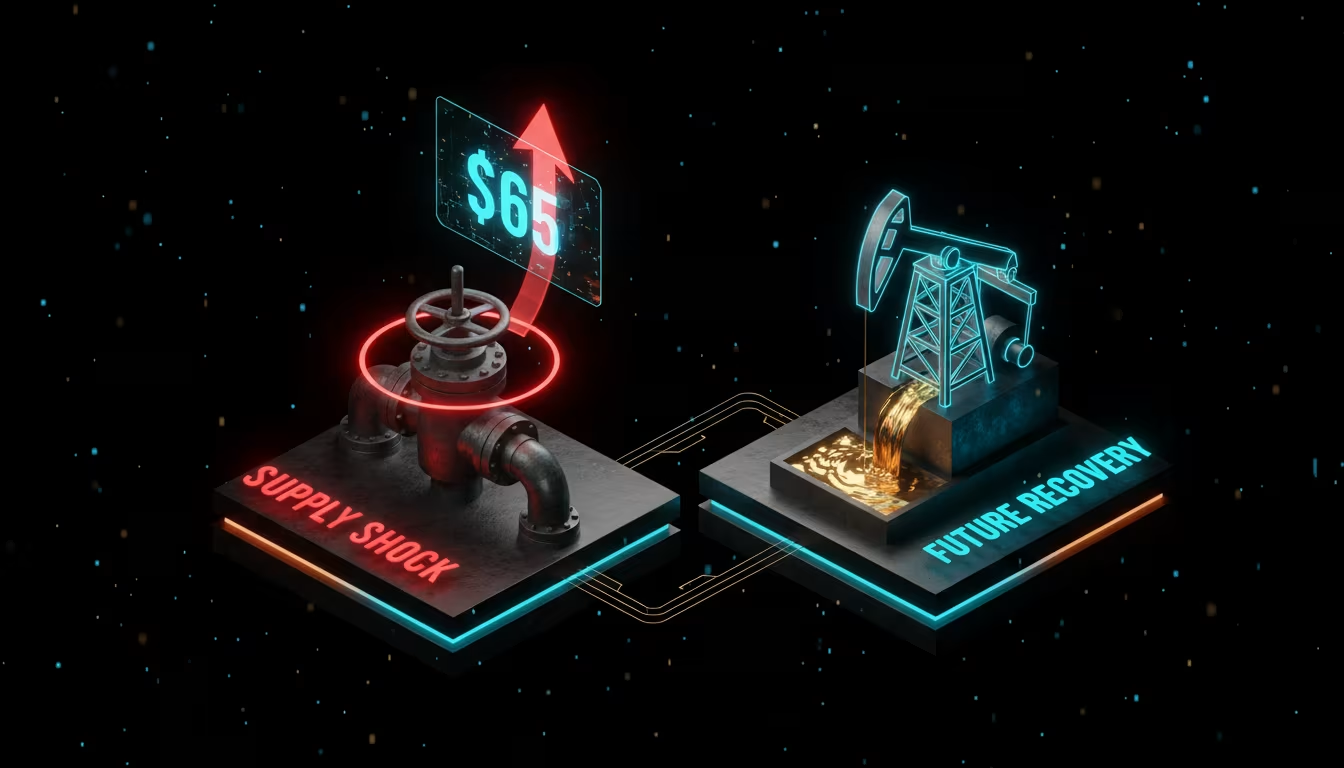
Short-Term: The "Geopolitical Risk Premium"
Whenever a major oil producer faces regime change, markets react with a "reflexive jump." Analysts expect Brent crude to test the $62–$65 range in early January 2026 as traders price in the uncertainty of Venezuelan supply.
The Reality Check:
Despite the headlines, Venezuela currently accounts for less than 1% of global supply. With a well-supplied global market and OPEC+ maintaining steady output, the "Maduro Shock" is expected to be absorbed relatively quickly.
Long-Term: The Bearish Case for Oil
If a stable transition occurs and U.S. sanctions are lifted, Venezuela could potentially add 500,000 to 1 million bpd within two years.
Downward Pressure: A revitalized Venezuelan oil industry, backed by Western majors like Chevron and Repsol, would increase global supply, potentially driving prices lower toward the end of 2026. However, restoring the dilapidated infrastructure will require tens of billions in investment.

The crisis has triggered a distinct "risk-on, risk-off" tug-of-war across various asset classes:
Sovereign Debt & Restructuring:
Venezuela has been in default on roughly $60 billion in bonds since 2017. The regime change has caused these "zombie bonds" to surge in price (trading in the 30–40 cent range) as investors bet on a massive debt restructuring. This could be one of the largest financial workouts in history.
Emerging Markets (EM) Risk:
The U.S. intervention has raised the "risk premium" for other emerging markets perceived as hostile to U.S. interests. Investors are watching for potential spillovers in Colombia, Brazil, and Mexico.
The Safe Haven Flight:
In the immediate aftermath, we’ve seen a strengthening of the U.S. Dollar and Gold, as investors seek protection against regional instability in Latin America.
Equities:
Interestingly, global equity markets (especially in the U.S. and Asia) have largely looked past the conflict, buoyed by the tech and defense sectors.
For a tech-driven financial firm like Waya, the Venezuela situation highlights the importance of geopolitical diversification:
Energy Transition: While oil remains the focus, the volatility in Venezuela reinforces the global push toward energy security through renewables.
Distressed Debt Opportunity: For institutional players, Venezuelan sovereign and PDVSA bonds represent a high-risk, high-reward play on democratic transition.
Commodity Volatility: Expect "gap-up" openings in gold and crude during the transition phase. Algorithmic trading strategies should account for higher volatility in energy-heavy indices.
The fall of the Maduro government is a watershed moment. While the humanitarian and political road ahead is long, the financial markets are already moving to price in a "New Venezuela."
At Waya, we continue to monitor these developments to ensure our users are ahead of the curve in an increasingly volatile global economy.
Stay informed. Stay invested.
Regards
Amit Vora, CEO